
June 6, 2025
How to solve critical data integration challenges with a strategic platform
Precog

Take a moment to think about all the different technologies your company uses today. It’s a lot.
Now think about all of the ways in which you need to connect data from each of those solutions. Once again, it’s a lot.
Bringing all of those data points together is essential for smarter, faster, and more confident decision-making. But it isn’t easy.
Here’s a look at the challenges organizations face today as well as how AI has enabled the way for a new solution that can deliver on the need to connect to any data quickly and effectively.
The Data Integration Challenge
Nearly all of today’s technology runs in the cloud, and these solutions use APIs to move data from one place to another. But APIs are like fingerprints – each one is unique to a given application – and that creates tens of thousands of potential APIs to which companies might need to connect.
To date, powering these connections has relied on ETL (Extract, Transform, Load) and ELT solutions. But current providers face critical challenges in today’s saturated SaaS application market:
- Scalability: Although tens of thousands of enterprise SaaS apps exist today, the market-leading ETL solutions only support a fraction of application connections.
- Fragmented Support: The limited scope of today’s ETL solutions means most organizations end up engaging three or four different vendors to meet their integration needs.
- Time to Value: It can take ETL vendors weeks or months to build new API connectors because doing so requires teams of engineers to manually build each one, which typically involves millions of lines of code.
These challenges have serious business impacts:
- Delayed time to value: Waiting months for a new API connector (and then having to ensure the data is flowing properly) is a huge blocker for business users to get critical insights from new applications’ data. This delays the ability to make more informed decisions.
- Complicated cost structures: Bringing on multiple ETL vendors not only creates more costs, but it also complicates the cost structure, leading to more work for application owners, IT, and Finance teams. Additionally, having multiple vendors creates unpredictable costs, as it’s unclear what teams might owe each one as data volumes fluctuate.
- Complicated support management: Multiple ETL vendors also means more complicated support. For example, if something goes wrong, teams need to determine which vendor supports the API connector in question and remember the connector request protocol with that particular vendor.
Critically, as the number of SaaS apps only continues to grow, so will the integration challenge.
Introducing the AI-Powered ELT Platform
Fortunately, a new solution is here – and it changes everything.
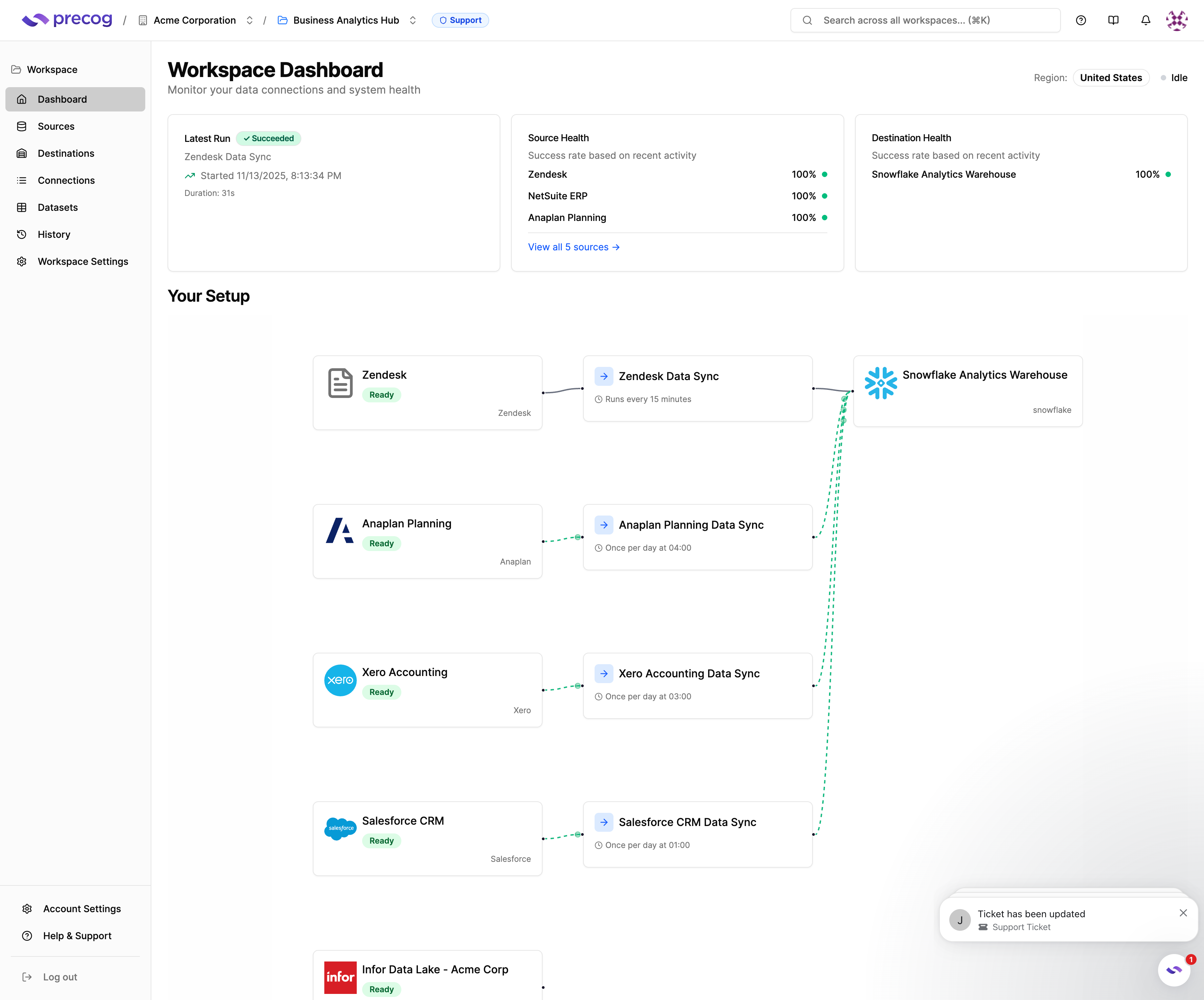
We now have access to an AI-powered ELT platform, which can automate the connection to any application for a more efficient and reliable solution. This automation stands in stark contrast to the lack of scalability and high cost associated with the status quo of manual development.
Here’s how it works:
- Buy a single platform that is guaranteed to meet all of your data connectivity needs quickly and easily – even those that don’t already exist.
- For any new sources, go through a 6-step prompt to answer questions about the applications and data environments involved – all in plain English.
- Wait a day or two for the new connection to show up in your account.
It’s simple, fast, and accurate – delivering key benefits like faster time to value, simplified vendor management, and stress-free maintenance. It’s also the only way that ELT will ever scale to meet the size of the current problem.
Get to Know the AI-Powered ELT Platform
The simplicity, speed, and accuracy of an AI-powered ELT platform are powerful benefits for organizations. Now, rather than waiting months to years for a new connector (or having to find a new vendor) and not knowing the effectiveness of it for your needs, organizations can control the entire process from start to finish, waiting only days for a new connector, and being totally confident in its effectiveness.
Ready to learn more about the AI-powered ELT platform and how it solves the data integration challenges that exist today and tomorrow? Click here to download our ebook, The Future of Data Integration: AI-Powered ELT Platform.


.svg)


