
January 22, 2026
Introducing Precog Automated Semantic Modeling: The Missing Link in Operational AI
Becky Conning

If you look at strategic initiatives across enterprises for 2026, the mandate to enable company-wide AI adoption is a top initiative for nearly every data leader. The promise is incredibly powerful: users simply ask questions to a Large Language Model (LLM), supplied with comprehensive data from the tools they use, and get immediate, accurate answers.
However, as enterprises rush to unlock these tools, they are discovering that realizing value is a far more complex and time-consuming process than initially envisioned. According to a recent MIT report, only 5% of integrated AI pilots are extracting any business value, despite the massive investment pouring into the sector.
The bottleneck isn’t access to AI interfaces or LLMs. It is often the lack of context surrounding that data required for these tools to make sense of it. Today, I am proud to announce a fundamental shift in how we approach this problem: Automated Semantic Modeling.
The "Context Gap" in Modern Data Stacks
To understand why scaling AI fails, we have to look at how data moves. Standard ELT tools and generic connectors are designed to move raw data from business applications without understanding it. They effectively throw massive payloads over the wall for analysts to decipher.
This creates a "Context Gap". Raw data from complex APIs lacks the structure and business logic required for LLMs to function. An LLM doesn’t inherently know how your specific organization defines "churn" or "gross margin" just by looking at a raw database table.
Historically, the burden of sorting it out fell on BI and data science teams. They spend months struggling to make sense of labels and relationships across thousands of tables and columns. This manual work to map fields and relationships to business logic is simply too slow.
But without this integral association, AI agents don’t work, or worse, hallucinate because they lack a business-specific semantic model. If the AI doesn't understand the meaning of the data, it cannot give you a reliable answer.
Precog Automated, Business-Aligned Semantic Modeling
We are pleased to introduce a powerful new feature that makes Precog the only data ingestion platform that can generate semantic models specifically designed for your business needs.
Precog combines our understanding of the data source, the structure of actual data and the use case intent to generate semantic models focused on specific business goals, maximizing performance, accuracy and real value.
With Precog, you now can automate complex data extraction from any SaaS business application and the semantic modeling required for reliable NLQ LLMs, MCP servers, AI agents and BI dashboards.
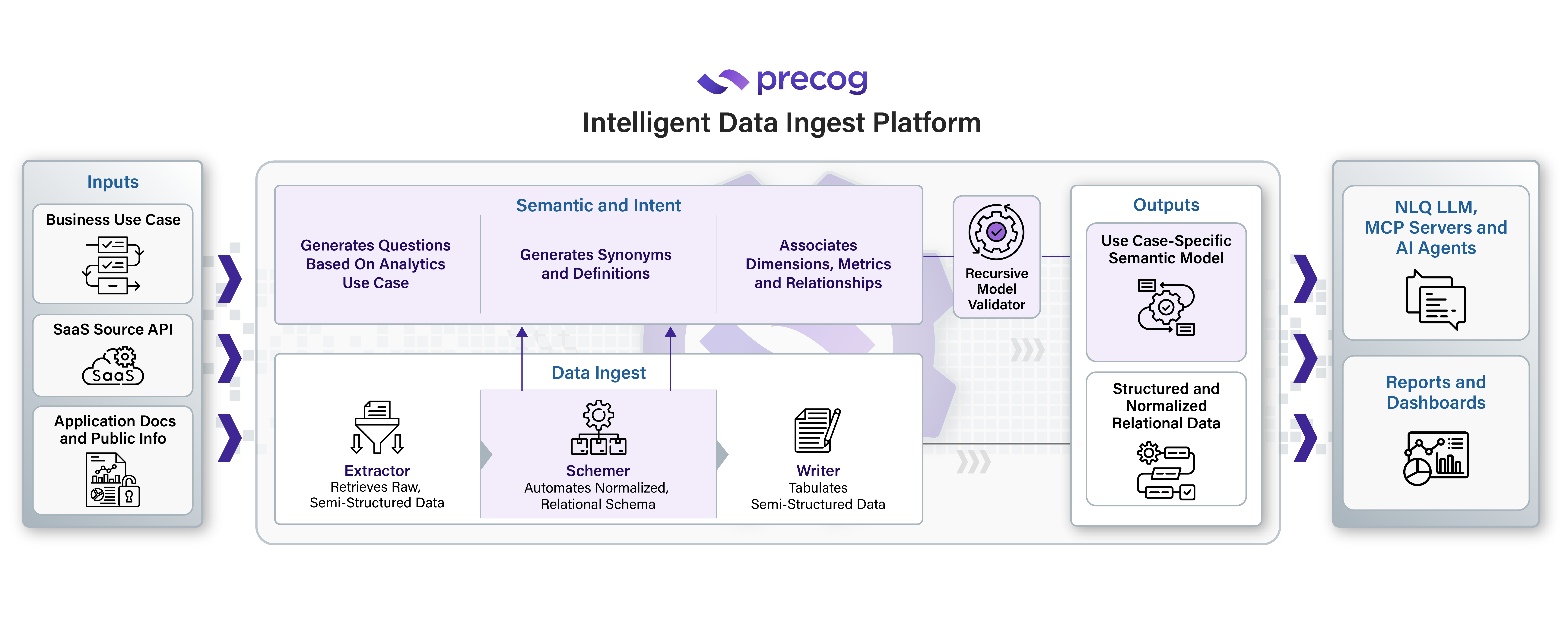
You provide the intent: When you set up a new source, you simply tell us what you are trying to achieve, in plain language. For example, "I want to optimize my inventory levels."
Precog automates data ingest: Our universal API connector is trained on hundreds of APIs to handle messy, nested semi-structured data and automatically deliver it as normalized, relational tables without any coding.
Precog generates the semantic model: We use this use case, combined with our deep understanding of the source documentation, public information about the source and the data itself, to generate questions in the problem space and associate relationships, dimensions, and metrics.
AI is instantly usable: The data and semantic models are delivered side-by-side so your organization can begin getting insights immediately.
Real-World Impact
Consider an Inventory Optimization use case. A warehouse manager might ask: "Show me large inventory items that haven't moved in six months, excluding returns".
In a traditional setup, answering this would require a data analyst to manually join tables from the ERP, the warehouse management system, and the returns log. But because our semantic model has already associated these disparate datasets and defined "movement" and "returns" based on your initial prompt, the AI chatbot can provide a verified list in moments.
Or consider a Customer 360 scenario. A sales leader can ask, "Who is likely to churn this quarter?" The system understands the specific business definition of "churn" tailored to your organization, delivering a confident answer rather than a guess.
Conclusion
We believe 2026 will be the year when companies push to make AI truly usable and derive real business value. But this is only possible if we first solve the data context problem.
Precog’s intelligent data ingest dramatically shortens time-to-insight, delivering business-ready data that your teams and your AI agents can work with immediately. By automating both data integration and use-case specific semantic models, we allow you to bypass the bottleneck of manual engineering and data science work and move quickly to intelligence.
Get more details and see it for yourself today with a 1:1 Precog demo. Existing customers wanting to get started can reach out to their Precog representative or submit a support ticket.
Additional Resources


.svg)


