
August 26, 2025
Three steps to improve warehouse capacity modeling
Joseph Arnold

Supply chain leaders are under constant pressure to balance efficiency, costs, and service levels. One of the most persistent challenges is warehouse capacity modeling – the ability to predict how much space, labor, and equipment will be needed to keep operations running smoothly. Get it wrong, and the business overspends on unnecessary storage or finds itself scrambling with space shortages that drive up costs and delay shipments.
In today’s environment of challenging demand patterns, complex product mixes, and rising costs, accurate warehouse capacity modeling has never been more important. Yet most organizations struggle to model accurately beyond a 3-month horizon. The good news: better data access across procurement, operations, and warehouse systems can dramatically improve outcomes.
The strategic importance of warehouse capacity planning
At its core, warehouse capacity planning is about ensuring that the right amount of storage space, labor, and equipment are available to meet demand. Unlike inventory planning, which is focused on the stock itself, capacity planning looks at the infrastructure and resources required to handle that stock efficiently.
Done well, effective capacity planning delivers clear benefits:
- Optimized space utilization – maximizing every square foot without waste
- Reduced costs – avoiding unnecessary expansions or leasing additional space
- Improved throughput and productivity – keeping goods flowing without bottlenecks
- Better service levels – ensuring orders are fulfilled accurately and on time
- Scalability and flexibility – adapting to seasonal demand swings and new business models
- Reduced risk – preventing safety hazards, congestion, and operational breakdowns
In short, effective capacity planning is a competitive advantage. But most organizations fall short of making it reliable at longer projection timeframes.
Why most companies struggle with longer time horizons
The reality is that while many supply chain leaders want to plan in longer-term cycles, few can model warehouse capacity accurately beyond three months. Only the most advanced organizations, those with sophisticated forecasting and machine learning tools, tend to achieve it. Why? Several barriers stand in the way:
- Demand forecast accuracy – Forecasting errors cascade into capacity planning errors, making predictions unreliable
- Data availability and quality issues – Missing or inaccurate data, like product dimensions or weights, throw off calculations
- Constraint management – True capacity is not just square footage; it also involves labor availability, equipment, throughput, and environmental requirements
- Product mix complexity – Different storage and picking methods make capacity needs harder to model consistently
- Coordination gaps – Silos between procurement, operations, and warehouse teams often result in mismatched inputs and misaligned expectations
Each of these factors undermines planning accuracy. Together, they explain why reliable long-term modeling remains elusive for most organizations
How data improves warehouse capacity modeling
The accuracy of any capacity model depends on the quality of the data feeding it. Without comprehensive and timely data, even the most sophisticated forecasting tool will produce flawed outputs. That’s why data visibility across the supply chain is critical.
Three types of data are especially important:
- Procurement data – Supplier order sizes, lead times, and purchasing patterns often drive sudden influxes of inventory
- Operations data – Inbound and outbound flows, labor schedules, and throughput rates reveal the workload the warehouse must handle
- Warehouse data – Slotting configurations, rack utilization, temperature-controlled zones, and product dimensions determine how space is actually used
When these datasets are complete and aligned, capacity planning becomes much more reliable. For example, procurement’s bulk orders will not overwhelm limited warehouse space if operations can see them coming and make adjustments in advance. Likewise, operations can staff appropriately for incoming surges rather than scrambling with overtime. Scenario planning for peak seasons or promotions also shifts from being reactive to proactive when all parties are working from the same set of accurate historical data.
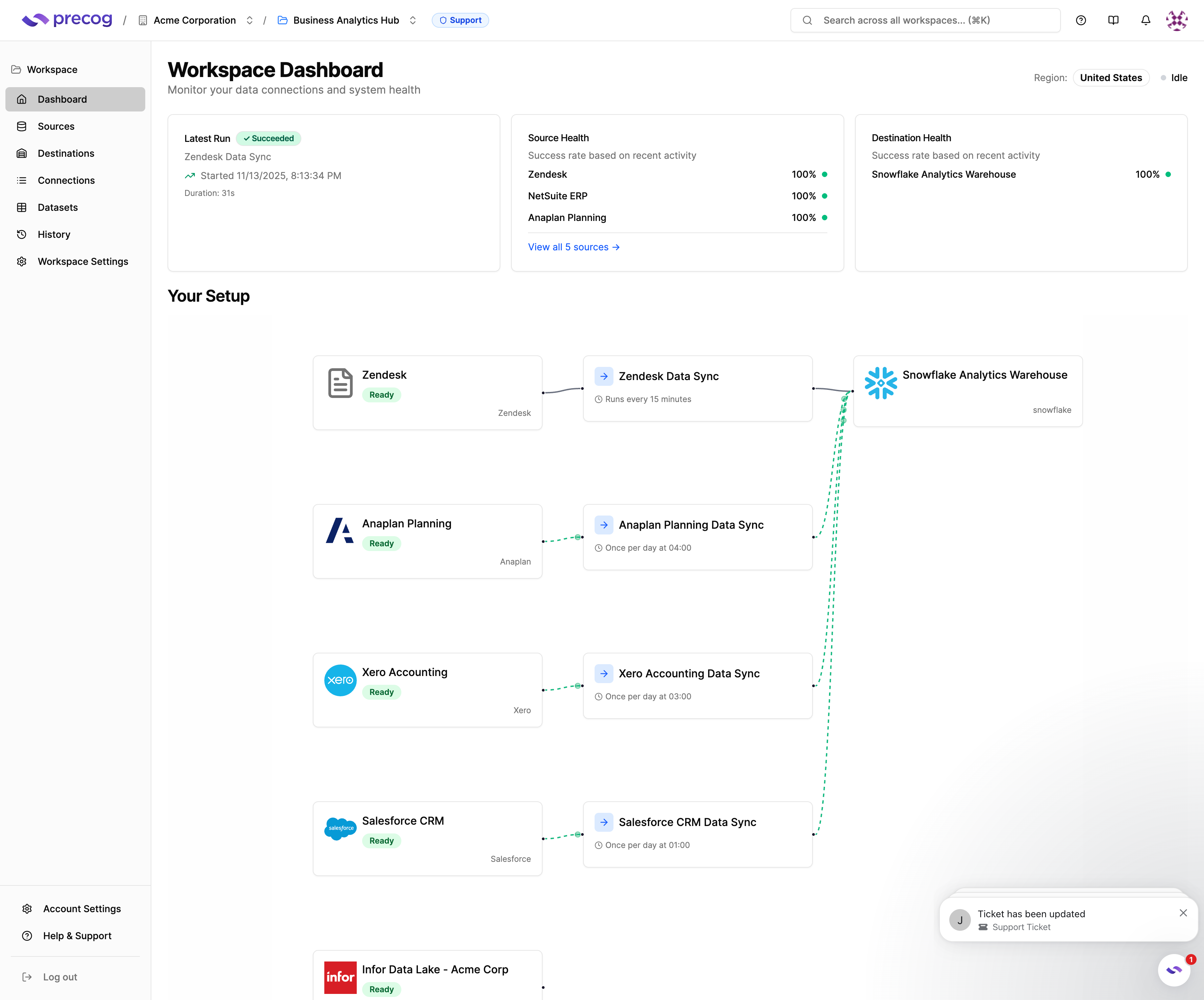
This is where Precog comes in. By automating the integration and transformation of data across siloed systems—ERPs, Warehouse Management Systems (WMS), Transportation Management Systems (TMS), procurement applications—Precog ensures supply chain leaders always have unified, accurate, and timely data at their fingertips. With trustworthy inputs, warehouse capacity models become a tool for strategy, not just firefighting.
Three steps to improve capacity modeling
For leaders looking to strengthen their warehouse capacity planning, here are three practical steps:
1. Unify data sources
Accurate capacity modeling begins with a single, consolidated data environment. Unifying procurement, operations, and warehouse data eliminates silos and ensures everyone is working from the same baseline. Precog plays a role here by automating data integration between ERP, WMS, market data and any other applications, providing complete and timely data for analysis.
2. Feed data into machine learning forecasts
Too often, organizations start here and underestimate the importance of complete, consolidated data. With unified and accurate data, organizations can feed machine learning software and other advanced forecasting methods, such as simulation tools, and deliver far better accuracy beyond short-term horizons. These methods thrive on complete and quality data, making integration the first step toward better predictions.
3. Continuously refresh models
Warehouses are dynamic environments. New orders, changing product mixes, and shifting labor inputs mean that static plans quickly become outdated. Models should be refreshed regularly with the latest data. With Precog automating the flow of data updates, supply chain leaders can ensure their models remain aligned with real-world conditions without added manual effort.
Turning data into a strategic advantage
Warehouse capacity modeling is critical for balancing profitability with cost control, yet most organizations still struggle to get it right beyond a short horizon. Poor forecasts, siloed data, and outdated tools continue to hold leaders back.
But the path toward improvement is clear: better data. With complete, accurate, and timely inputs across procurement, operations, and warehouse systems, capacity models can shift from reactive guesswork to proactive strategy.
Precog helps supply chain leaders unlock that potential by automating what’s often a complex process to unify data, ensuring capacity planning is always grounded in reality. For organizations looking to maximize profits while managing costs effectively, now is the time to reimagine warehouse capacity modeling, built on the foundation of better data. Schedule a demo to see it for yourself.


.svg)


